Researcher in Artificial Intelligence-ML, Cybersecurity & IoT | Digital Forensics Trainer
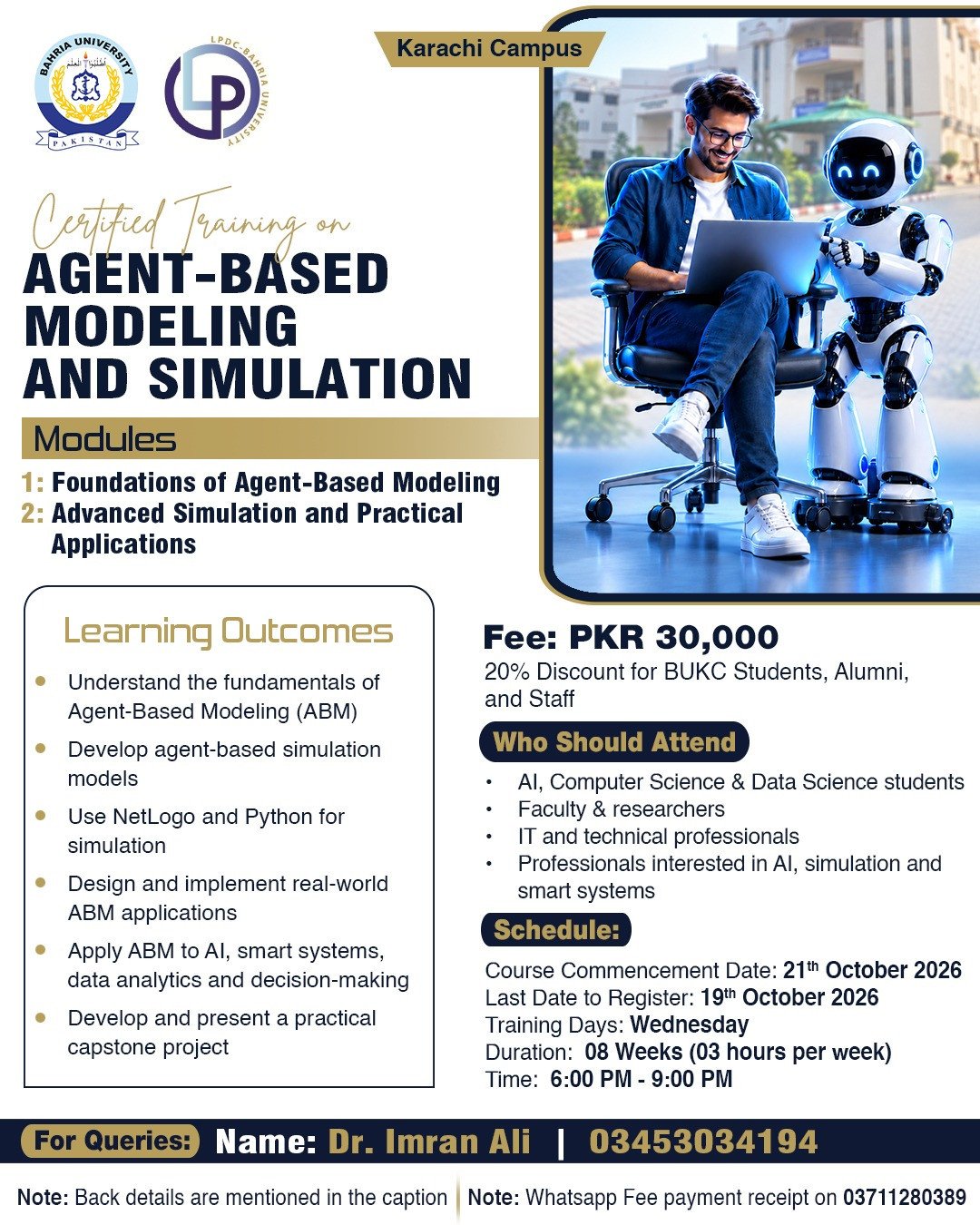
...Agent-Based Modeling and Simulation
Practical: 8 Session Professional Training Program
Duration: 8 Weeks Total Duration: 24 Hours Sessions: 8 Sessions Recommended Duration: 3 Hours per Session Theory: Approximately 20% Hands-on Practical: Approximately 80% Primary Tool: NetLogo
Module 1: Foundations of Agent-Based Modeling Duration: 4 Weeks | 12 Hours
Module Outcome
Participants will understand the basic concepts of Agent-Based Modeling (ABM), intelligent agents, agent behavior, and conceptual modeling, and will be able to develop simple ABM simulations using NetLogo.
Session 1: Introduction to Agent-Based Modeling & NetLogo
Key Theory
? What is Agent-Based Modeling (ABM)?
? Why do we use ABM?
? Agents, environment, behavior, and interactions
? ABM vs. traditional modeling
? Introduction to NetLogo
? Basic NetLogo interface and model components
Hands-on Practical – First ABM Model
? Install/open NetLogo
? Explore the NetLogo interface
? Create agents (turtles)
? Create an environment (patches)
? Move agents
? Change agent properties
? Run a simple simulation
Expected Output: Students create and run their first working NetLogo simulation.
Session 2: Intelligent Agents – Perceive, Decide & Act
Key Theory
? What is an intelligent agent?
? Agent and environment
? Perception ? Decision ? Action
? Simple reflex and goal-based agents
? Agent attributes and behaviors
Hands-on Practical – Intelligent Agent
? Create agents with different properties
? Give agents simple rules
? Make agents observe their environment
? Make agents make decisions
? Implement actions based on conditions
Expected Output: Students understand how an agent senses its environment, makes a decision, and performs an action.
Session 3: Agent Behavior, Interaction & Rules
Key Theory
? Agent behavior
? Agent-to-agent interaction
? Interaction rules
? Cooperation and competition
? Basic agent decision-making
Hands-on Practical - Classroom/Population Simulation
? Create multiple agents
? Define interaction rules
? Control agent movement
? Create conditions for cooperation
? Create conditions for separation/avoidance
? Observe emergent behavior
Expected Output: Students learn how simple rules can produce complex group behavior.
Session 4: Conceptual Modeling, Parameters & Model Design
Key Theory
? Identifying agents
? Identifying environment
? Agent attributes
? Rules and behaviors
? Model assumptions
? Parameters and variables
? Basic model experimentation
Hands-on Practical - From Real Problem to ABM Students select a simple real-world problem and identify:
? Who are the agents?
? What is the environment?
? What properties do agents have?
? How do agents interact?
? What rules do they follow?
? What parameters can be changed?
Expected Output: Students produce a basic ABM design and start implementing it in NetLogo.
Module 2: Advanced Simulation & Practical Applications Duration: 4 Weeks | 12 Hours
Module Outcome
Participants will be able to develop more advanced agent-based simulations involving multiple agents, spatial interactions, decision-making, learning, communication, and real-world applications.
Session 5: Multi-Agent Systems, Cooperation & Communication
Key Theory
? Multi-Agent Systems (MAS)
? Cooperation
? Competition
? Coordination
? Communication between agents
? Basic swarm behavior
Hands-on Practical - Multi-Agent Simulation
? Create different groups of agents
? Define communication rules
? Implement cooperation
? Implement competition
? Create agent-to-agent messages/signals
? Observe group behavior
Expected Output: Students create a basic multi-agent system with interaction and communication.
Session 6: Spatial Modeling & Agent Decision-Making
Key Theory
? Spatial environments
? Grid-based modeling
? Agent location and movement
? Goals and decision-making
? Basic sequential decisions
Hands-on Practical - Spatial Simulation
? Create a grid-based environment
? Place agents at different locations
? Define targets/destinations
? Create movement rules
? Make agents select actions based on their surroundings
? Experiment with different parameters
Expected Output: Students develop a spatial ABM and understand how the environment affects agent decisions.
Session 7: Learning, Adaptation & Real-World ABM Applications
Key Theory
? Feedback in agent-based systems
? Adaptation
? Learning behavior
? Basic reinforcement-learning concept
? Real-world applications of ABM
? AI assistants, smart cities, healthcare, finance, and autonomous systems
Hands-on Practical - Adaptive Agent
? Create agents that receive feedback
? Change agent behavior based on previous results
? Compare agent behavior before and after adaptation
? Experiment with different rules and parameters
Expected Output: Students understand how agents can adapt their behavior based on experience and feedback.
Session 8: Final ABM Project – Development, Testing & Presentation
Key Theory
? ABM experimentation
? Testing and validation
? Interpreting simulation results
? Model limitations
? Ethical considerations and human-agent interaction
? Future applications of ABM
Suggested Project Areas
? Traffic simulation
? Disease/spread simulation
? Classroom/student behavior
? Smart city
? Crowd movement
? Customer behavior
? Emergency evacuation
? Swarm intelligence
? Autonomous agents
? IoT-based agent simulation
Project Activities
1. Define the real-world problem.
2. Identify agents and environment.
3. Define agent properties.
4. Define interaction rules.
5. Develop the NetLogo model.
6. Run experiments.
7. Change parameters.
8. Observe and interpret results.
9. Test the model.
10. Present the final simulation.
Expected Output: Each participant/team presents a working ABM simulation and explains how the agents, environment, rules, and interactions work.
Practical-to-Theory Structure
Component
Approximate Weight
Basic concepts & theory
20%
Demonstration
10%
Guided hands-on activities
30%
Individual/team practical work
30%
Final project & presentation
10%
Total Practical/Applied Learning
80%
Course Instructor: Dr. Imran
Date: 29/08/2026

Researcher in Artificial Intelligence-ML, Cybersecurity & IoT | Digital Forensics Trainer.
.